This LFX Mentorship 2026 Term 1 with kube-burner (CNCF) was a great experience for me. I was fortunate enough to work on Enhancements around Kubernetes performance testing .
Background
During my Master’s degree, I stumbled upon Docker and quickly fell in love with how a single container could run anywhere. That curiosity naturally led me to Kubernetes. My college senior was running full SIEM stacks on bare-metal clusters QEMU + KVM, Vagrant, kubeadm, Proxmox, Ansible — and watching him work made k8s feel less intimidating and more like an adventure.
My thesis took it further. I built a Kubernetes-Based Secure Browser Isolation Platform on a bare-metal RKE2 cluster. I got to know about kcli , it helped me provision production-grade Kubernetes clusters from scratch. With the cluster up, I used client-go, Istio, MetalLB, and Guacd for scalable RDP, then validated performance with Playwright stress tests, measuring HPA/VPA scaling events, etcd/kube-apiserver resource usage, and P99 WebSocket RTT.
What is kube-burner?
kube-burner is a Kubernetes performance and scale testing framework widely used in the CNCF ecosystem (e.g., by Red Hat for OpenShift). Using a YAML config, it creates objects at scale, measures latencies, collects Prometheus metrics, and indexes the results. It’s often the tool behind large-scale cluster performance benchmarks.
How I Found the Project (Before LFX)
My path to kube-burner started before the LFX program. While working on my thesis, my ad hoc Python performance scripts weren’t cutting it, I needed structured, reproducible results. That search led me to kube-burner.
I cloned the repo, read the code, and started contributing in November 2025. Three PRs merged before applications even opened:
PR #1045: pprof DaemonSet for Node-Level Profiling : Added automated DaemonSet-based profiling for node-level processes (kubelet, cri-o) with node affinity, RBAC setup, and readiness checks. Tested on a k0s + CRI-O cluster via kcli. The maintainers (@rsevilla87, @sferlin) were direct, technically sharp, and genuinely engaged , that first interaction set the tone for everything after.
PR #1047: --set Flag for Config Overrides : Helm-inspired CLI flag to override any YAML config value (--set jobs.0.jobIterations=100), eliminating the need for separate config files per test variation.
PR #1052: Multi-YAML Document Support : Enabled multi-document YAML (--- separated) in object templates , essential for deploying grouped resources like Istio Gateway + VirtualService.
Having three merged PRs before the application period, I believe, played a big role in getting selected.
 That feeling when your first few PRs get merged
Getting Selected for LFX Mentorship
The Linux Foundation Mentorship (LFX) Program is a structured, paid 3-month mentorship where you work on open-source projects under the guidance of experienced maintainers. My application for kube-burner Term 1 ‘26 (March–May) was straightforward: I pointed to my existing contributions, described the some of the issues like usng —dry-run to cli flag a gap I had identified, and wrote a proposal.
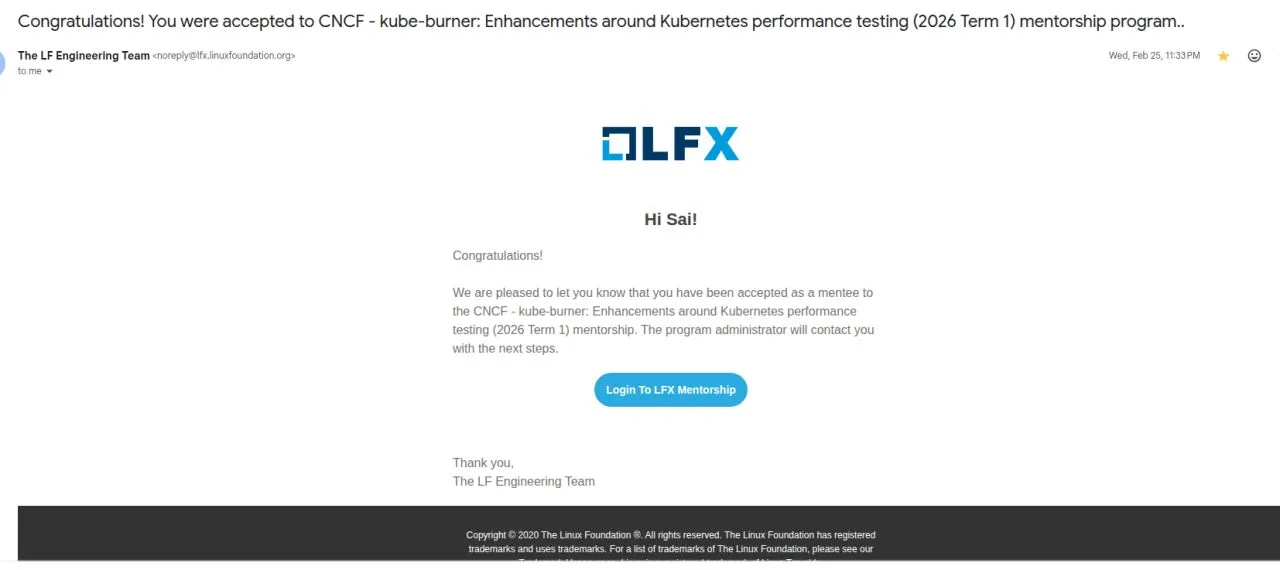
The moment I got the acceptance email was surreal.
The Mentorship: What I worked on
PR #1068 Job Hooks: Shell command hooks that run at specific points in a kube-burner job (beforeDeployment, afterDeployment, etc.). The background: true mode runs hooks in a goroutine alongside the main workload built with goroutines, wait groups, channels, and mutexes for proper lifecycle handling.
PR #1119 Templated Kinds: Moved GVK (Group-Version-Kind) resolution from startup to render time, so templates with dynamic kind names like TestResource{{.Iteration}} work correctly unlocking CRD-based workloads.
PR #1180 --dry-run Validation: Validates your entire workload config (template syntax, GVK availability, RBAC permissions) without creating a single resource. Modeled after ClusterLoader2’s approach with graceful degradation when no cluster is available.
PR #1198 Measurements Format Migration: The most challenging refactor. Unified all latency measurement types (pods, PVCs, VMIs, nodes, etc.) into a consistent JSON schema using Go generics (GenericLatencyDocFactory[T any, L ConditionSetter]), making downstream analysis significantly easier across all 10 measurement types.
PR #1246 UUID Bug Fix in TSDB Indexer: Fixed the output directory being literally named collected-metrics-{{.UUID}} instead of substituting the actual UUID. One-line fix, real impact.
The Big One: KEDA Performance Testing
This is what the mentorship was ultimately building toward. KEDA (Kubernetes Event-driven Autoscaling) is a CNCF graduated project that lets you scale workloads based on external events like message queues or metrics. But despite being widely adopted, nobody had a reliable way to performance-test it at scale.** A GitHub issue requesting automated load testing (KEDA #4411) had been open since **March 2023**, and users were reporting serious slowdowns scaling delays stretching to hours (#6063) and API throttling under moderate load (#3810) — with no tool to reproduce the problems consistently.
The Implementation
PR #1234 is the core deliverable. It adds a measurement plugin that times each step of KEDA’s scaling process so you can pinpoint exactly where slowdowns happen, a ready-to-use test workload that spins up message queues, triggers autoscaling, collects performance data, and cleans up — all in one run — and performance profiling support for capturing CPU and memory snapshots from KEDA’s internals. Along the way, I also fixed a bug (issue #1235) where kube-burner would hang if a profiling target wasn’t reachable.
In May 2026, I opened KEDA issue #7746 to propose using this as KEDA’s official CI performance check — run the benchmark on every release and catch regressions automatically. The maintainers were receptive and tagged it for discussion, which is exactly the kind of early feedback that helps upstream contributions land smoothly. A big shout-out to @vishnuchalla, who helped me refine the proposal to KEDA maintainers, cleared my doubts on using kube-burner, and pointed me to the right docs when I was stuck.
Lessons Learned
This experience taught me valuable lessons about open-source collaboration. I found that getting involved early and doing thorough research helped set a solid foundation. Along the way, I realized that filing clear bug reports is just as important as writing code, and that tackling unfamiliar concepts like Go generics, Goroutines, Context, Performance profiling, Prometheus metrics collection and Kubernetes internals can be highly rewarding. Most importantly, I learned that open source is an ongoing conversation; simply asking “does this make sense?” before coding often led to the best outcomes and helped me learn from the maintainers.
What’s Next
I would still contribute to kube-burner and help the community in any way I can. I’m looking forward to contributing more to other CNCF projects I’m passionate about.
If you’re interested in Kubernetes performance testing, come say hi in the kube-burner Slack channel (#kube-burner on CNCF Slack).
Final Thoughts
Three months ago, I had a vague idea that Kubernetes needed a performance testing tool for applications running on it : ClusterLoader2 already exists for testing Kubernetes itself, but nothing filled the gap for workload-level benchmarking. Today, there’s a concrete implementation, an upstream proposal, and a community conversation that didn’t exist before.
LFX gave me the time, the mentorship, and the accountability to take a good idea all the way to production.
You can find all my contributions at: